Getting there
I went to Peru. With two of my friends. Kelly and I dated years ago. Now she lives in Atlanta. LeAnna and I play softball together in Portland. And, strangely enough, she and Kelly met each other in Ireland, even more years ago. The three of us discovered that we were all considering hiking the Inka Trail and decided that we’d make a go of it together. After months of planning, Kelly had found us great accommodations and a fantastic tour company, and LeAnna had navigated the oddities of the local airlines. I just tagged along. I think maybe the brought me as the entertainment.
We started our trip on the fourth of July, meeting and flying out from Miami. We looked out from the airplane windows to see hundreds of fireworks displays below us, cheering us on our way.
This was a big adventure. I was just one week back from Italy, where I’d spent a month, but already Peru was shaping up to be a bigger adventure. It struck me that Italy was now a familiar place. A place with a familiar sound and smell and taste. Peru was completely new. I’d never been to South America. I’m not sure I’ve ever been to Mexico. And although I grew up in the mountains of Idaho, the 12,000 foot altitude of Cuzco seemed worlds away.
And that’s where we were headed: Cuzco, via Lima, where we would acclimate for a couple of days before the trek.
The first real excitement of the trip began in Lima where we navigated the complexities of purchasing a ticket on a local airline. We were unable to purchase a ticket online. We could reserve, but not purchase, so once in the Lima airport, we needed to pay for our tickets – in cash, at a special counter. Fortunately, Kelly and LeAnna had been practicing Spanish, and I had been speaking Italian for a month, so I could understand a fair bit. My college Spanish threatened to re-emerge, but never really followed-through.
After Kelly and LeAnna took care of their tickets, we found out that, for some reason, I was booked on a flight an hour and a half later than the flight the other ladies were on. Not good. The shuttle to the hostel was not likely to wait or return for me. I’d have to work it out when I got there. Alone.
Kelly handed me a map and told me the name of the hostel. Then she wished me luck, and they ran to catch their plane, which was scheduled to leave very, very soon. I stood in line to check my bag for the later flight. I’d been told by the agent at the payment desk that I could not get on the earlier flight. Darn.
But I am my father’s daughter. He traveled extensively while I was growing up, a manufacturer’s rep for an international company. We’d traveled as a family, and I’d seen him work with desk agents. He’s magical. I’ve seen him talk an entire family onto a full flight. I’ve seen him get free first class upgrades for all four of us. When it comes to travel, there is almost nothing he can’t do. Or at least that’s the mythology I’ve developed. A mythology that can come in handy when I’m in a foreign country needing to be emboldened to make a little magic of my own.
So, as I approached the desk, hefting my 35lb pack, I focused, and I channeled my father – in Spanish. Or Italian. It’s not clear what I was speaking, exactly.
I asked the agent if I could get on the early flight. She looked at her watch and asked another agent. Who went to work, typing frantically on her keyboard. I felt like I was on the Amazing Race. They worked together, speaking rapidly and in low tones. Finally, the second woman nodded, and the first took my bag to label it. Then she handed me a small, squarish piece of paper. I looked down and saw that it was a ticket. For the early flight.
“Esta bien?†I asked.
“Si.â€Â She looked at me staring at her in awe. “Rapido!â€
I smiled, nodded, and took off running.
Then I heard her behind me. I’d forgotten my water-bottle. We both hopped over the ropes that separated the lines of travelers. She smiled broadly, handed me the bottle, and I was off, looking for Kelly and LeAnna who still thought I was on my own. I found them in security, after being turned around and sent to pay my airport tax.
In Peru, you cannot enter or leave the country, or even fly domestically without paying a tax. When we flew to Cuzco, we paid about $8 American. When we left the country, it was about $30.
Once the tax was paid and the validating sticker attached to my little ticket, I was able to run through the checkpoint, and into security. “Kelly! LeAnna!â€Â They looked back at me, in the middle of taking off their shoes. “I’m on!â€
We all smiled and celebrated, and they waited while I danced through the metal detector. Then we made a break for the gate. We arrived 15 minutes before the departure time, just as they were closing the door to the runway. We were sure we’d missed the flight, but the gate agent put up her hand, made a call, and then pointed us through the door and to a bus. Well, we were pretty sure which bus she pointed too…
We were elated. We’d all made the flight. We snapped pictures, and chattered through our grogginess.
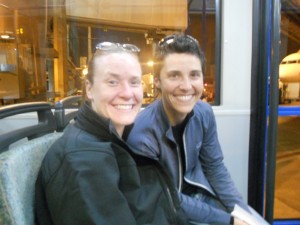
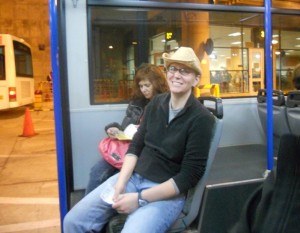
After 10 minutes of sitting in an empty bus, we started to worry. There was almost nobody on the bus, and the flight was supposed to be leaving in 5 minutes! Kelly couldn’t take it. She walked off the bus to confirm that we were in the right place. The airport worker checked his watch and told her that, yes, we were on the right bus and that we’d leave in a bit.
Apparently, departure times are kind of a general rule, more than an absolute. The bus filled up with people and we took off.
The hour and a half flight was a treat. Primarily in Spanish, we were instructed about safety, and handed snacks. It reminded me of air travel in the US 15-20 years ago. We had leather seats, as much as we wanted to drink, and a meal complete with breakfast sandwich and cookies. All for about $100. Maybe less.
I usually sit on the aisle, but I would have sat on the wing to get on this flight. As luck would have it, I was on an aisle, with an occasional view out the window. I watched as locals and returners looked out to see the terrain becoming more and more rugged, mountains emerging from plains.
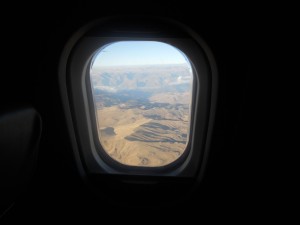
The approach to Cuzco was a little intense. The mountains were close on either side, and we turned hard to get to the strip. And extreme landing for an extreme place.
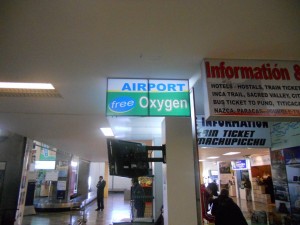
On the ground, we celebrated again with high fives and acknowledgements that “We’re in Peru!â€Â In the shadow of the “Oxi Shot†sign, we repacked our bags and wondered if we’d really need the canned oxygen during the next week. I laughed and made some Spaceballs “Perriair†joke that nobody got.
It was 8:30AM when we walked outside to find our shuttle. The sun was piercingly bright in the thin mountain air, leaving the sky intensely blue, and the hills surrounding the city a washed-out brown.
Our shuttle turned out to be a guy with a car. We located our names on his list and convinced him that we were the ones he was there to pick up. The we tried to locate our seatbelts, and held on tight as we rumbled through the city over cobblestone streets, through plazas, and to our hostel.
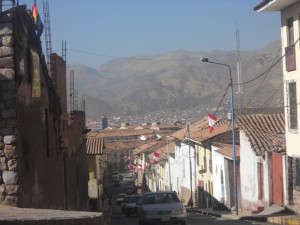
Our driver came to an abrupt stop on a steep, one-way hill and we hopped out. The adventure, though just officially beginning, had already given us a lot. And, packs in hand, we were ready for more.

August 1, 2010 6 Comments
Market of the Farmers
Decatur has a “Farmers Market.† It’s not Portland, so it’s not like our farmers markets. I mean, I’m sure there are farmers who produce the products, but I’m not actually sure they ever go to the market. Still, there are some pretty visual things that happen there.
Here are some of them:
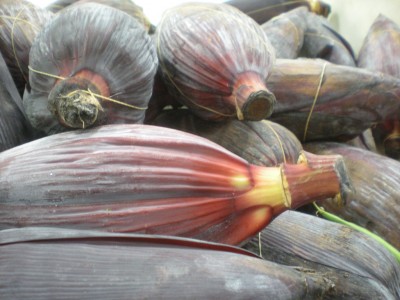
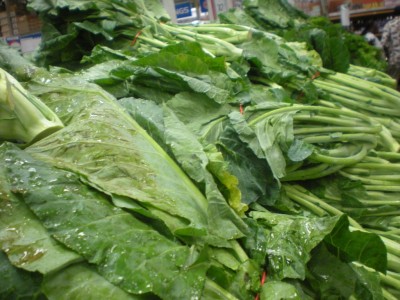
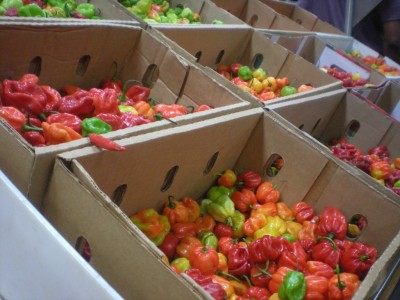
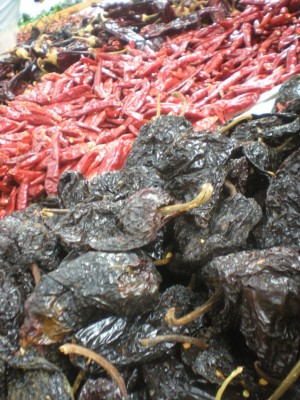
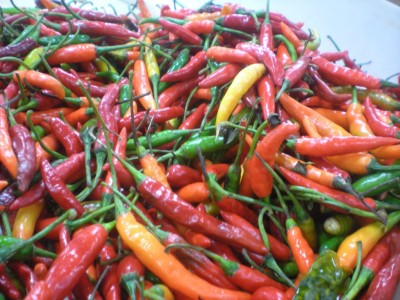
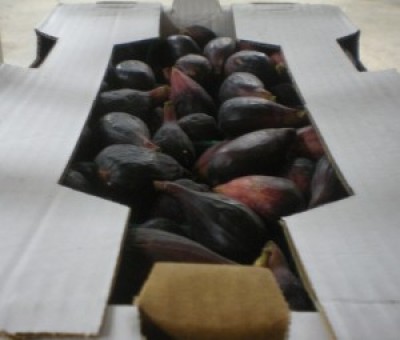
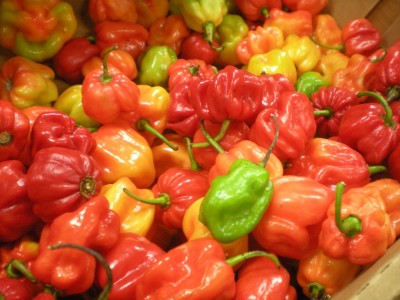
Yummy.
July 27, 2010 5 Comments
Stone-shocked
I’d heard about Stone Mountain. On my last trip to Atlanta 6 years ago. More in passing conversation, as an inside joke that I didn’t get. “Some people are going up to Stone Mountain tomorrow.â€Â “You going?â€Â “Yeah right.â€
“What’s Stone Mountain?â€Â I’d asked blindly.
A few people stared at me while someone answered flatly, “It’s like a Confederate Mount Rushmore.â€
I’d been intrigued ever since. That intrigue was only heightened by the episode of “Undercover Boss†that included a stint at the amusement park that surrounds the landmark, focusing on the WWII duck boats that shuttled visitors through part of the park.
So when Kelly, the friend who had instigated the Peru trek we were about to embark upon, handed me her keys and a map and told me to head out to Stone Mountain for a bit of hiking, I was totally game. “See what time the laser show is,†was her only instruction.
She’d bought the season pass to the park as part of her preparation for Peru. Stone Mountain, with its strange geography was a good place to get some uphill trekking in. But an Achilles injury had kept her from using the pass fully, so she was eager to have me take advantage of it.
I studied the map, and headed out. The mountain was about 30 minutes away. As I drove, I sang to the radio, watching a bubble in the Earth’s surface growing.
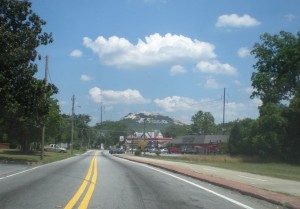
The further I drove out of the suburb of Decatur, the bigger and louder the trucks became, and the further from home I felt. I know it sounds cliché, but it was my experience. At about 40 minutes, I looked in my rear-view mirror and saw the mountain. Crap. I’d sung myself right past the place. I turned around and hoped I’d be able to use the bubble to navigate myself back. Even so, I wasn’t completely sure which turn to take to get to which gate. My usual half-lost-but-okay-with-that self was fading a bit as the monster trucks seemed to crowd nearer to my little Acura at stoplights.
I found my way back to the village of Stone Mountain, and wound through the streets toward the stone. After a couple of wrong turns within the park, I located the right parking lot and a sign to the trailhead.
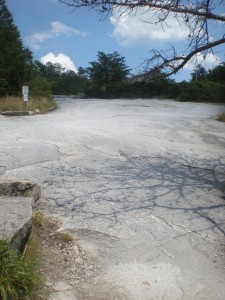
Which wasn’t much of a trailhead. Just a stone face. I paused for a moment to see where other people were going. And they were going up. Straight up the stone. I followed them, interested in a new adventure, and struck by the really strange geology of the place.
Green scrub reached out, sending fingers of scratchy brush along the stone face. Trees grappled with the ground, finding a hold. Great swaths of smooth stone were exposed from the thunderstorms that hit the place regularly.
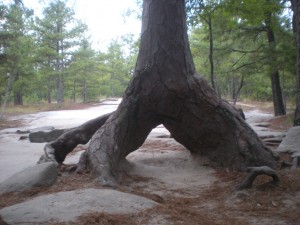
Bobbing along through the scrub, I looked around, side-to-side, up and down, taking it all in. This wasn’t so bad. Strange and all, but still… And then, about 100 yards in, I froze a little inside.
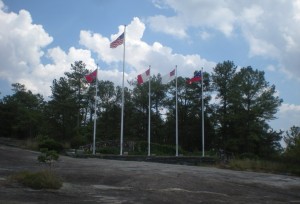
Yes, I know the Confederate battle flag is a symbol of independence; of rebellion. But where I come from, it means more than that. For a lesbian alone in the woods, it means quite a lot. My ex-girlfriend of 4 years was from the south. From Alabama. And she’d tried to explain the flag’s significance. I’d never really understood completely. It was like trying to understand the utility of the pink triangle.  I was curious, but uncomfortable. I looked over at the display of flags, considered stopping, and then sped up, happy to move out of the clearing, and wondering what else I might find.
What I found was a moonscape. It is, quite literally, like nothing else I’ve ever seen. The “mountain†seemed to be dropped out of the sky, or left behind by an incomprehensively large glacier.
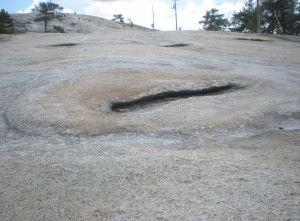
Pitted and strange it stood, as people, like ants, climbed its face and carved their loyalties into its side.
I climbed with them, wondering if they could sense my unease. I climbed with trail runners, and German tourists. I climbed with families, black and white, who seemed either oblivious or unconcerned with the blatant history of the place. I wondered, blithely, whether I’d take my children to an anti-gay monument to go hiking.
The top of the mountain is large, and flatish, the edges dropping dramatically to the greenbelt below. I did a circuit, looking over the side, wondering where the Confederate generals were carved. Until I found what I was pretty sure was the place, based on the grand, grassy viewing area below.
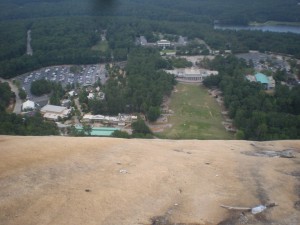
And the gondola platform.
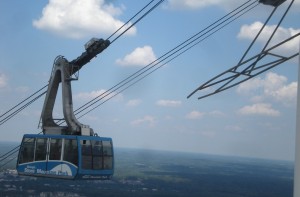
With the gondola shuttling people from the ground to the top of the stone. For what, I’m not sure. I’ve ridden the tram in Portland just to say I rode it, and to see the views on the way to Oregon Health Sciences University. Maybe it’s kind of like that. I’m not sure. Or like riding a ski-lift to the top, in order to see the view. And I have to say that the views from the top were spectacular. It was as though I was looking down on the city from a meteor. It’s possible that I was.
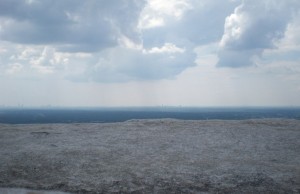
The place was strange.
Have I mentioned that? The geology alone was strange enough. Smooth sections, then great pits, then strange bumps adorned the surface.
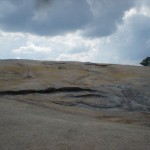
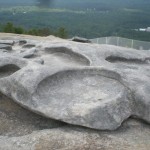
Normally, I’d find a quiet spot, sit, and commune with nature for a bit. But I felt unsettled in this place. It reminded me of the feelings I’ve had when I’ve visited prisons. As a 6th grader on a field trip, or an attorney for the state. There’s a violence in the air. A stripping away of something. A deep unrest sat about the rock, and I couldn’t tell whether it was the people, the weather, or the place itself, churning with a displeasure. I watched the skies change, and the vultures circle. And then I made a break for it.
As I jogged down the stone face, the rain started, dotting the thirsty surface, and making everything incredibly slick. Only once did my shoes fail. On the steepest part, I slipped backwards, arms flailing out to grasp the handrails that jutted from the steep ground, waiting to catch unwary visitors.
When I reached the flags again, I decided to stop. The rain was coming down lightly, and my curiosity was even greater than before. I carefully read the placards in front of each flag, considering the combined history. The frustrated history of mistaken identity: Stars & Bars was changed to the battle flag, so as not to be mistaken with Stars & Stripes in a fight. The battle flag incorporated into the white field of the second national flag, which had to have a vertical, red bar added later, so as not to be mistaken for a flag of truce.
That’s a rough history for a movement. Seems a little confusing. I tried to commit it to memory, as I walked the last bit of the trail to the parking lot, past the African-American families headed up the mountain with beach chairs under their arms.
Before I left the park, I wanted to see the carving. I know very little about the Civil War, other than I was taught that it was about slavery, and my ex was taught that it was about trade embargos. I couldn’t tell you who the heroes of the war were, or where the important battles happened. But I still wanted to see the generals carved into the side of the stone.
I drove around the edge of the park until I saw a sign for the plantation and the “memorial lawn.â€Â It sounded promising. I walked past the boarding area for the gondola, where Star Wars music was being pumped like IV fluid to the excited families waiting to fly to the top, through a whitewashed colonial-style building that vomited air-conditioning into the Atlanta heat, and out onto a viewing area.
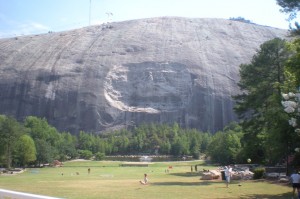
Stonewall Jackson, Robert E. Lee and Jefferson Davis rode across the face of the rock, their horses given equal billing on the informational signs.
I stood there, battling my fight or flight response. Fascinated. Petrified. Now, I’d like to make it clear that I’m an intelligent person. That I’m fairly rational. That I have deep interest in things that are different from my experience. I often seek these situations out, ready to confront my unease. But here, the unbelievable discord of the place crept into my cells. It still does when I think back on it. And I couldn’t find a way through it.
So I tried the nature path. The path led past flags of the confederate states. Scarcely little information was provided. Too bad, really. I was happy to learn more. But I’d have to do it online. I walked down to the front of the lawn and back around. I saw the scenic railroad cars filled with tourists. I saw the high-ropes course and the recreated “Crossroads†town. I saw the white families playing volleyball in the shadow of the mountain, and the young black men wearing “Stone Mountain†polo shirt uniforms as they staffed the attractions.
And then I left. Uncomfortable, but curious. And excited to talk with my Atlanta friends about what all I’d observed – sure I was missing some major dynamics that would help it all make sense. (In fact, as I write this, I’m sure there are people who will be willing to tell me how I got this all wrong, and why, exactly, this is understandable. And probably how racially and socially insensitive I am. That’s great. I’d like to know.)
Only, when I got back to the house, my Atlanta friends looked at me like I was a small child, unable to really understand. “Am I missing something?â€Â I asked, after describing the black workers and picnicking families.
“Hmmm,†is about the extent of what I got in response.
I tried again a few days later with another friend who had grown up there. “We’re thinking of going to the laser show at Stone Mountain. Want to join?â€Â The Stone Mountain laser light show is legend. Confederate glory lasered on to the face of the mountain and set to classic rock. According to the website, there also seemed to be some kind of tribute to Elvis. My friend was not interested.
“It’s just a bunch of rednecks,†was her response. She didn’t go much beyond that when I probed further. I didn’t find that response especially helpful.
It wasn’t until I posted about my experience on facebook that I got anything more. A law-school classmate who had grown up in Atlanta, and happened to be African-American, responded to my “am I missing something here?†post.
“No, not missing anything. That kind of crap is just so engrained there that people don’t notice it … It’s still very much the old south for much of the population mentally. Took me leaving to realize how truly creepy the laser show is (or even just the carving by itself). Like I said, issues.â€
Indeed. When I googled Stone Mountain, I found out that the man who carved Mount Rushmore had originally been involved in the carving of Stone Mountain. Interesting enough. I also found out that the KKK had re-org meetings on the top of the place. You know right around where the tram lets people off to visit the gift shop. And the snack shop.   I think maybe society has some issues. Or maybe I have some issues. I don’t know. But, for the first time, I found myself unable to understand. Unable to come up with some storyline that made sense of what I was seeing. But I guess it made sense to the German tourists. I don’t know. I just don’t know.
July 26, 2010 3 Comments
Carriaged away
Over the last year, I’ve begun to play with the idea of groundlessness. At least that’s what Pema Chodron calls it. She’s a famous, respected Buddhist nun. I’m a wanderer. Or I have been. So, without really meaning to, I’ve been on a spiritual journey, becoming familiar with the unsettled feelings that come with not having a home. With not knowing, exactly where I’ll be sleeping in a month or a week or a day. Sometimes I’m tied up in knots, anxious over the unknowing. Other times, I’m light, carefree. I land on my feet. I have amazing friends who have taken me in and put a roof over my head. I have family that would shelter me for as long as I need. I am fortunate.
The day before I left Italy for Atlanta, I was in a fit of groundlessness. Both of the places I’d planned to stay in Atlanta had fallen through, and then reemerged. When I left Italy, actually got on the plane, I didn’t know where I’d be staying when I landed. I sent an email to both of my friends asking them to talk amongst themselves and let me know where I should tell the taxi driver to drop me.
I checked my phone as I waited in the customs line in New York, and found that I’d be staying with my friend Kelly for a few days. I’d camp in her attic room – in June – in the Atlanta heat – without air conditioning. Then I’d transfer over to my friend Linda’s place, passed around like a smiling football. This was fine by me. I’m a pretty easy traveler. Not a lot rattles me, and I’m happy to sleep almost anywhere.
Kelly was set to pick me up at the airport when my late-night flight arrived. That changed, though, around hour 3 of sitting on the tarmac in Ney York. Hour 3 of sitting between 2 giant guys, after I’d traded my specifically selected aisle seat with a woman who wanted to sit with her daughter. “I bet this isn’t what you had in mind when you switched.â€Â She was right. I pick my seats very specifically. At this point I’d been traveling for about 26 hours. I talk about culture shock pretty regularly, but sitting between two big black guys for three hours, in a hot-ass, non-moving plane, trying to make small talk about a church conference was a seriously challenging re-entry.
When we finally made it to Atlanta, I was in an okay place. I was channeling my father, ready to figure out how to get a hotel room in the area, and take the shower that I’d been dreaming about for about 12 hours.
I cruised to the front of the plane when the seatbelt sign went off, waved to some of the friends I’d made on my Pisa NYC trip, and booked-it to baggage claim. Where I proceeded to wait for over an hour. Long story short, I ended up filing a lost-baggage report, and receiving a little toiletry bag from the airlines. It was nice. It even had a t-shirt for me to sleep in. As I filled out the report, the agent asked me to describe my bag. “Point to what kind it is,†she said, handing me a laminated card, and smiling kindly.
“It’s a backpack.â€Â I pointed at the diagram and handed it back to her.
“Oh, did you check oversize? That’s where backpacks go.â€
No, no I had not checked oversize. My bag was not, in fact, oversized. So I signed my report, just in case, took my little gift bag and headed to the oversized baggage area. My little bag, in its friendly, green rain cover was there among army duffels, and weaponry.
Clinging to my post-bag-retrieval high, I sauntered up to the bank of reservation phones to book a hotel. I studied the colorful pictures, and familiar hotel names. My dad was a traveling sales man, so I grew up spending family vacations in hotel rooms earned with frequent flier miles and points. Each logo evoked a specific emotion or memory of sandy beaches, and amusement parks.
I called through the friendly logos, finding each of them booked. Evidently, the airport had been practically shut down for two days due to the thunderstorms that had kept us grounded in New York. Stranded travelers had already filled the best hotels. Around the time I was calling my 10th hotel, I started making friends with the other travelers standing in front of the phones. We warily traded information: All of the Holiday Inns were booked, the number for the Comfort Suites was incorrect.
And then we all found an opening. I can’t even remember the hotel name, but it was close, and it had rooms. One after the other we called, booking whatever we could, happy to get on a shuttle and get some sleep. It was 1AM and we were collectively exhausted.
We made our ways to the shuttle area and waited. When the van pulled up and the doors opened, we stood back to let the others off.
“If you are going to Ramada, don’t. It has bedbugs and mold.â€Â A group was piling off, clearly jacked up on adrenaline and drama. We weren’t headed to the Ramada. We were headed next door. I tried not to think about how far bedbugs could travel, and whether mold would matter if I was spending 7 hours in the room…
The hotel was dingy, trapped in the early 80s. We waited outside a semi-secure vestibule large enough for 2 people, and stifling in the Atlanta heat – even at 1:30AM. Through bullet-proof glass I paid my $69 and received my key. The desk clerk pointed to the room closest to the street, and across from the pool/vending/front desk. All I could think about was a shower and a pillow.  My carefree traveling self was fading, slowly replaced by a character from Planes, Trains and Automobiles.
I keyed in, looked around, and stuck my head back out the door to give the thumbs-up to the others who were still waiting for keys. We’d wondered whether we’d have better luck across the street at the Highland Inn, or something like that.
Backpack balanced on a chair; shampoo in hand, I headed into the bathroom. And found that there was no hot water. None. I let the shower run, hoping it would warm up. I jiggled the handle and tried the sink. Zero. I thought feebly about asking for another room, but I the bed’s tractor beam pulled me in, and I passed out on the way to the door. I’d shower in the morning.
I didn’t move for about 6 hours. When I woke up, it was still with thoughts of hot water . Which did not exist. Not in my room, at any rate. No matter, Kelly was coming, and I could get a shower at her place. I packed up and waited for her call.
“Hi!†came her chipper voice. “I’ve got a great day planned for us. We’re going to head to coffee, then to breakfast, then to a meeting, then somewhere fun, and then home tonight. Make sure you get a shower. â€Â Crap.
It’s been a while since I took a submarine shower. I’m not so good at them. Fortunately, halfway through the chilly ordeal, the hot water appeared, out of nowhere. I did a little dance, and scrubbed a couple of days of bus, train and plane rides off of my body.
I checked out, and thought about how mildly grumpy I was that I had to pay for a crap-ass hotel room. Fortunately, I’d be spending the week with people I loved. I tried to focus on that, not wanting Kelly to know how un-great my night had been.
When Kelly arrived, it was with some news. She’d run into her neighbors on the way out of the house.  They were headed to the airport for a 3-week vacation. That meant that their carriage-house – a beautiful space with a full kitchen and bathroom – was empty. Quick-on-the-draw Kelly had secured the space for me.  She was a little apologetic when she described the place, afraid that I’d be disappointed not to stay with her. But the idea of my own bathroom and air conditioning was a dream.
We spent the day tromping around the city, eating, drinking coffee, and catching up. When we rolled up to Kelly’s place, and she pointed to the neighbors’, I laughed.
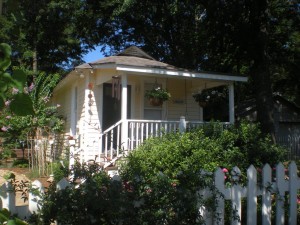
It was more beautiful than anything I could have planned. Nestled into a gorgeous backyard, with its own porch and swing, the carriage house was perfect. I crunched up the gravel drive, through the white-picket-fence, and opened the door. The burst of cool air that met me at the door made me laugh again. Kelly headed to her place, and I set to unpacking. I drew a bath in the clawfoot tub, and made some tea on the stove. Then I kicked back in the oversized chair, thinking about the fact that Kelly would never have run into the neighbors if my plane had been on time. I drifted off, smiling about the $69 I’d paid for the week-long stay at the carriage house, and knowing, once again, how wonderful groundlessness can be.
July 23, 2010 2 Comments
Iberian splendor
Okay, here it is. The big meal. Every trip seems to have a big, memorable meal for me. In Atlanta, this was it. I honestly was trying to find a pizza place, to grab a slice of mediocre “New York style†cheese pizza. But, as I walked through Decatur Square, I stopped in front of a smooth-looking restaurant to read the menu.
Damn. I knew I was hooked almost immediately. They had a nice outdoor seat for me, in the cool-enough Atlanta evening. I quickly made friends with my waiter, Daniel who, when I asked his name, handed me his business card (I thought this was a nice touch), and we started moving through the menu.
Something I learned in Italy was the benefit of taking advice. Some advice, about what to eat, from the wait staff. These people know the food intimately. They see it all day long. They smell it. They eat it. They see what gets sent back, and know what the chef is most proud of.
Tonight I took my Daniel’s advice. “You’ll be good if you order the special salad and the red quinoa.â€Â Okay, not what I was thinking, but why not? I’d eaten late in the day, and my slice of pizza was quickly turning into a full-blown, serious meal. I had a conversation with my stomach and prepared myself.
Or so I thought.
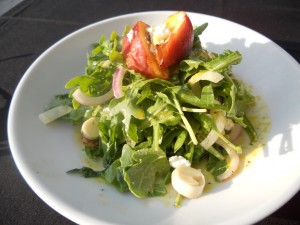
The salad, which was big enough to be a meal in its own right, was beautiful. It was endive and arugula with seasoned Marconi almonds, grilled peach, and goat cheese. Holy yum.
I savored every scrap of it, listening to the lesbian couple next to me bicker about whether they would allow their infant daughter to know the family members they didn’t like, and whether people who don’t work are just a drain on society.
I just smiled at my salad.
A fool, I had debated with Daniel about whether I should have the quinoa (I love quinoa), or something else I can’t even remember now. The quinoa erased all memory of competing meals.
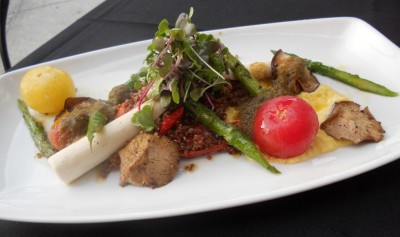
I’ll try to reconstruct the combinations of flavors and textures, because it was precisely these combinations that made the plate of food sing. The quinoa, which was nutty and beautiful, had a delicate crunch, and sat on a bed of roasted red peppers. Slightly roasted. Roasted just enough to concentrate the flavors, while leaving the soft, sweet flesh tender. That sweetness paired beautifully with the tangy tomatillo salsa, and the crunchy, salty asparagus that had been slightly braised. The magnificent corn sauce was entirely of its own flavor, creamy and sweet. Independent in the way it made the whole, stewed tomatoes edgy, and the mushrooms even more elegant.
I’d been worried about the mushrooms. Generally, I’m a fan, but shitake can border on the slimy, chewy, nasty side for me. I have to say, though, these were the star of the show. They were marinated, seasoned and sautéed in a way that made them tender and succulent.
The endive and microgreens were lovely as well. The finished off the piece, giving it a light, clean feeling.
I spent a good amount of time, studying the dish, which was beautiful and inviting. I paired different parts and evaluated each combination. It was as much entertainment as meal. Even as I became increasingly, uncomfortably full, I wanted to make sure I’d tried everything fully before abandoning my attempt.
Daniel glided past a couple of times making eye contact long enough for me to smile, give the thumbs up, or nod vigorously. When he saw a slow-down in the action, and approached again, he was smiling. “Dessert?â€
Now, I wasn’t hungry. I was, in fact, unhungry. But it’s almost always worth hearing the list, in my experience. He went through a litany of tasty treats, gelato, tort, etc. And churros. With a chocolate dipping sauce.
I’d heard tell of such things existing in far off lands like Spain. My experience of curros was relegated to Disneyland and Costco.
“What’s made in-house.â€Â The question had served me in so very many situations, and I pulled it out now with relish.
“Well, the churros.â€Â He was a little sheepish telling me that they didn’t make everything there. It wasn’t a problem for me, though. The churros sounded delicious, and I didn’t really want anything huge, so it was a win-win.
“And an espresso. Let’s do this thing.â€Â Daniel smiled a conspiratorial smile and headed to the kitchen.
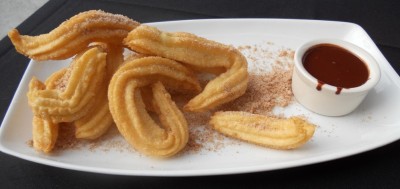
I sat in front of the plate of fried, sugared delight. It reminded me of an edible Calder staybile. You know those giant steel sculptures that look like mobiles that have fallen to the ground? Yeah, maybe it’s an obscure reference, but it’s the truth.
Passersby gawked. Kids. Adults. Dogs. I could hear the lesbians whispering next to me, and after an hour of ignoring each other, they finally asked what I was eating. The power of the churros was strong.
“How is everything?â€Â Daniel was back.
“You might want to give people a heads up about the size. I’m getting stares.â€Â He giggled and looked at the ground.
The churros were hot. They were extruded and fried-to-order. Which was perfect. I thought I’d finally make it through a meal in Atlanta without a fried course. Nope. The fried dough had a wonderfully crispy exterior, and an airy, doughy inside. The tubes were the size of a big carrot, and crunched with a satisfying sound when I chomped into them.
The chocolate dipping sauce was slightly spiced, and equally hot. Throwing all concerns about staring lesbians, I dip pieces of churro in the sauce, and then into the surplus cinnamon-sugar on the plate. The chocolate dripped on the way to my mouth, and I soaked it up with more fried dough. There were enough churros for four people. And I ate them all. Every last one.
I paid my bill and laughed at what my little piece of pizza had turned into. Then I moved Spain further up my list of places to visit. Pretty much for the churros.
July 22, 2010 Comments Off on Iberian splendor