The other Americans
It was early when we got up. Thankfully, the excitement of the trail pulled us out of bed, and the promise of a good breakfast drew us into the dining area.
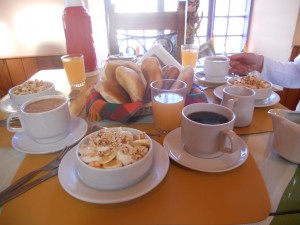
It was 4:30. We had 15 minutes to throw down breakfast and get our bags to the front door for our shuttle pick up that would take us to the start of the Inka Trail.
And that was the goal. The Inka Trail. We were signed up for the 4-day trek that would take us some 29 miles through the jungles of Peru to Machu Picchu. Kelly’s foot was acting up, which meant LeAnna and I would be going it alone. Well sort-of alone. We were trekking with a group – the only way to hike the trail after the mudslides earlier in the year.
During our briefing in the trekking office the night before we’d inquired about the others in the group. There were 5. We got visibly excited when our guide told us there were Israelis, Britts and a German. Then he laughed at us. “No, all Americans.â€Â Darn. We liked our countrymen just fine, but it was exciting to think that we might have some kind of a cultural exchange with the other trekkers.
We climbed into the van at 4:45. It was already filled with our new companions and a couple of our porters, short, dark, smiling men wearing woolly, knit hats with ear flaps and tassels.
LeAnna and I crawled across the second row of bench seats and settled ourselves in for a nap. The others talked animatedly about their trip so far, the beeping watch that one of the girls refused to fix, and about the sickness that had ravaged their group. Seriously? Sickness?
LeAnna and I shot sideways glances at each other. The idea of spending 4 days with a sick person wasn’t entirely appealing. The idea of doing it while hiking to 14,000 feet and sleeping in tents was almost too much.
We drove up and out of Cuzco, watching the villages come alive with workers preparing for the day. After a quarter of an hour of tattling along the roads, we pulled over and one of the porters hopped out. The porters would be carrying our food, and non-personal gear. This guy returned with a propane tank the size of the tank for a barbecue. It weighed 35 lbs according to our guide, Odon. We felt bad for whoever would be hauling that thing. Little did we know…
The terrain was serious. Steep mountains reminded me of the cliffs I’d seen in Japanese scrolls, and the towns nestled in the valleys buzzed with life, streams of smoke rising from rooftops.
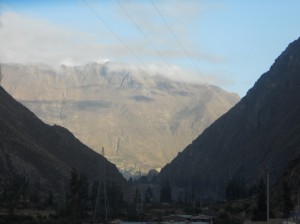
We dozed off and on, LeAnna, our porters, and the other Americans. The small, dark man next to me put his chin to his chest and drifted off, our arms touching gently in the crowded van. Between unconsciousness, I opened my eyes enough to get snapshots of my surroundings. The tall mountains, the deep rivers, the bull rings, standing out like red and white targets.
Our arrival into Ollantaytambo, the starting-place for the trek, was unceremonious. We pulled our little van alongside the enormous tour busses and stepped out into a crowd of swarming, buzzing locals selling their wares. Emergency ponchos, energy bars, rubber tips for hiking poles (I actually bought some of these), everything we could possibly need was pressed onto us as we made our way up the stone streets. We were allotted 45 minutes to shop, use the bathroom, and eat.
LeAnna and I walked away from the crowd and tried to take in our surroundings. We were in the mountains. That was for sure. And there were ruins at the far side of the town: deep steps built into the side of the steep slopes.
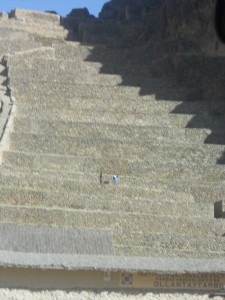
We barely had time to catalog them as we reeled around. The importance of the elements was clear. Not only were the mountains ever-present, the streets ran with swiftly flowing water channels.
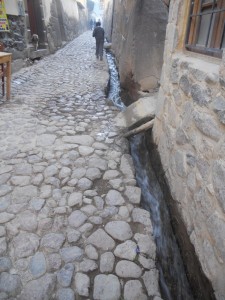
They provided a water-source for every member of the community.
We weren’t especially hungry, but we knew we’d be hiking for something like 8 hours that day, so we decided it was a good idea to eat. We found a funky place, the Living Heart Café, founded by a British woman who wanted to provide education for local children and opportunities for local women. We had quinoa porridge. It was good. Darn good. We scarfed it down, along with a cappuccino (for good measure) and tried to figure out if the other Americans in the restaurant were our trail-mates. It had been so early when we met them that we weren’t sure.
And then we were back at the van for the short ride to the trailhead. There was more talking in the van now, as we drew closer to our next adventure.
At the trailhead, LeAnna and I checked and re-checked gear, discussed our plan for the day, and posed, fresh-faced, for each other’s cameras.
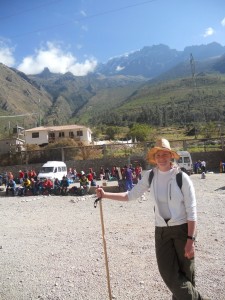
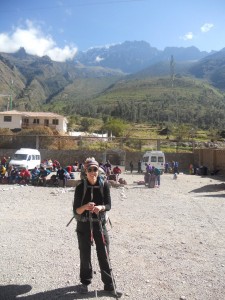
There was much adjusting of packs. When I decided to hike the trail, I decided that, aside from food and tent, I wanted to carry my own gear. It was an issue of pride for me, to prove to myself that I could carry what I needed. I became even more attached to the idea when I found out I was the oldest person on the trek. That’s right, me. At 33, I was the eldest of our group. Insane. So I was hyper-prepared. I had my pack packed tight. I had it on my back , with my trekking poles set. I had coca leaves and tons of water accessible to prevent altitude sickness. I was ready.
When Odon, our guide, called us together, LeAnna and I were first there. We waited as one of the others, in a loud voice, helped his entire posse adjust their packs. We refrained from rolling our eyes, and waited patiently. I noticed how heavy my pack was, and checked that the coca leaves were close by. We were starting the trail at 12,000 feet above sea level.
After our final briefing, we headed to the trail, and paused for the obligatory group photo.
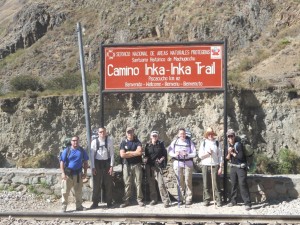
Odon patiently worked through all 6 of our cameras that were swinging from his wrist. I considered the blue skies and the gorgeous mountains. And I reached for my coca.
Now, before the trip I’d heard from everyone who had gone, “drink the coca tea.â€Â I’d decided, however, that I didn’t need to be ingesting a substance; that I could do the trek without. That is perhaps true. However, after spending 3 days in Cuzco, I knew what an altitude headache felt like, and I wasn’t interested in having one on the trail with 30 lbs on my back.
So I took the leaves, which looked just like bay leaves, and I crunched them up. Then I stuck them in my cheek. I stuck a lot of these crushed-up leaves in my cheek. If you are or know anyone who is a tobacco chewer, you probably know that this is not the way to chew a leaf. The correct way, as I would later find, is to take the entire, dry leaf, moisten it in your mouth, and then fold it gently into your cheek.
By the time we’d reached the checkpoint 1/8 of a mile in, my mouth was numb.
“My mouth is numb,†I said, turning to LeAnna. “It almost tastes like Novocain.â€
“Um,†she said, looking an even mixture of alarmed and amused, “that’s what they make Novocain out of.â€
My God, she was right. I spit the green bits out as much as I could, but they were still wedged between my teeth. I didn’t really have time to deal with the coca situation, however, as we were almost immediately climbing. We crossed the Urubamba River and headed up.
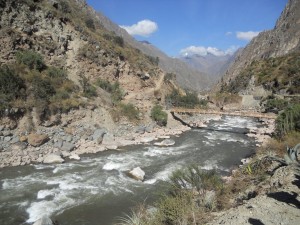
I swear to you, I thought I might very potentially die. I wondered if I’d have a heart attack, if I’d black out and fall off the side of the cliff, or if my body would simply give up. We were 5 minutes into the trek. It wasn’t good.
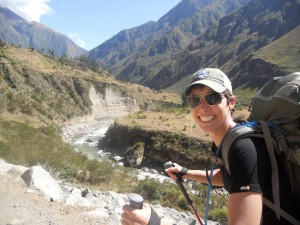
I don’t know how, but I managed to muster one last grin as I was gasping for air and trying to settle my thundering heart. I was honestly afraid for my physical wellbeing, and equally afraid to show how much trouble I was having.
But the trail leveled out, and I was able to catch my breath – roughly. I was still a little distressed by the pace that Odon was setting. I was in pretty decent shape, but I hadn’t been training at high altitude, and I hadn’t been hiking for 8 hours a day, nor with a big pack. LeAnna seemed okay, and the others weren’t far behind us. One big voice was booming on, but everyone else seemed to be quieting down. Maybe they were experiencing the same shock I was. I don’t know, I was focusing on breathing.
Twenty minutes in, we hit the first checkpoint. It was a bend in the ancient rock trail where local vendors had tiny stands selling Gatorade and toilet paper. We sat in the shade of an enormous avocado tree. Odon pointed at the fruit that was the size of my hand and told us it was small fruit. “In a month there will be a hundred of them, this big.â€Â He held his hands to indicate something the size of a small cantaloupe.
I looked around at the stray dogs that, even here, were ubiquitous. Â Â A tiny, three-legged dog hobbled around, more at ease than I was.
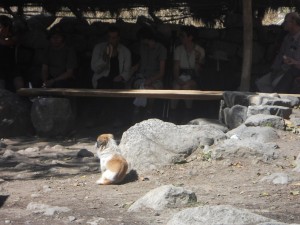
I chuckled to myself.  Great sign for what was ahead.
We left the checkpoint after a 15 minute water break, Odon in the lead.
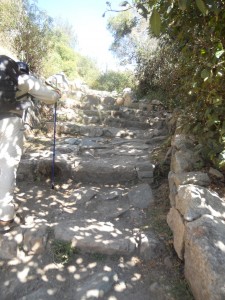
All thoughts of a “paved path with handrails†were abruptly shoved from my mind. Whomever had told me that I’d be disappointed at the commercialization of the trail had no idea what they were talking about. For real.
Another half an hour on, we came to our first archeological site. One thing I hadn’t expected from the trip was all of the archeology. I thought we’d hike a long-ass trail and then arrive at Mochu Picchu. The sites that we visited each day were a brilliant surprise.
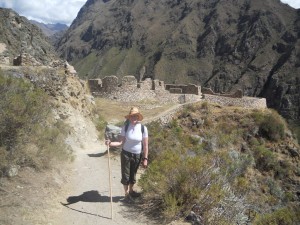
From this site, we looked down onto a bigger site, and across the river to one of the original Inka trails that connected the great, ancient cities of the Inkan empire.
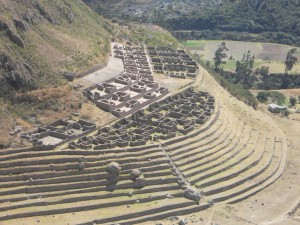
We spent some time wandering around the site, listening to Odon’s explanation and marveling at the enormity of where we were.
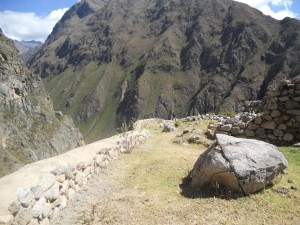
Then we headed on to lunch. We hiked another hour before we saw the green and yellow of the food tent that would serve as a beacon for the next four days, signaling rest and food were near.
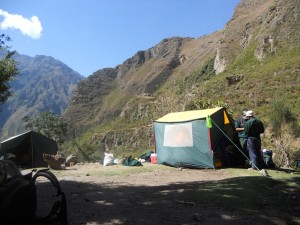
Our beautiful porters were responsible for carrying the common gear. The tents and the plates and the food. They literally ran ahead of us with ridiculously-huge packs on their backs and set up for us, preparing beautiful meals. We tossed our packs onto the tarp that was lovingly laid out for us, hurled our bodies onto the packs, and promptly, and collectively fell fast asleep.
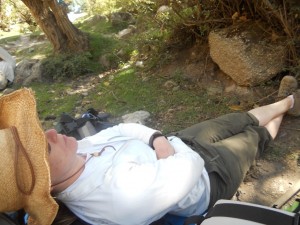
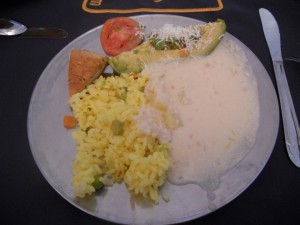
I’m not sure if the smell of the food or the porters voices woke us up. We dragged ourselves up from the ground and into the little tent. The food began simply with bits of garlic bread and corn soup. And then it became a huge tray of saffron rice, stuffed avocados, and a cheese pudding.
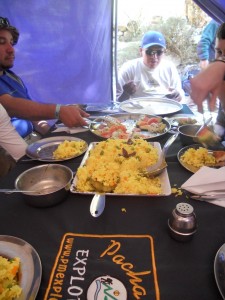
It was clear that my concern about eating as a vegetarian was unnecessary. Even though they carefully prepared egg dishes for me whenever the others ate meat, I would have been more than fine eating all of the other food that graced the table at every meal.
The meal, like every meal, ended with tea and coca leaves. I was the only one to add the leaves to the hot water. I had no intention of feeling the way I had earlier in the day. I grabbed a banana, and stuffed it down. I also had no intention of running out of steam on the trail.
We had at least another 3 hours left on the trail for the day, and though we could have lain down, each and every one of us, and slept through the night, we had to shoulder our packs and head on. This was the test day. Odon was watching us to see who would be able to make it over the pass, and who would be sent back. This wasn’t a test any of us wanted to fail.
The trail meandered up and down, and we all walked together, more or less. Odon would stop us every so often to wait for those who were taking a little longer, or to sit and talk with a friend along the trail.
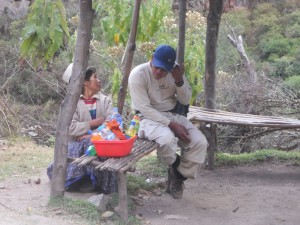
Odon was fascinating. He had spent years as a porter. Carrying the packs of other people up and down the trail. Now he hikes the trail once a week. ONCE A WEEK. We did some quick math and figured that he’d hiked the trail something like 500 times. That, my friends is amazing.
The terrain changed a bit from dusty plains to high-steppe. The sky continued to shine a startling blue, and the snow-capped mountains got gradually closer.
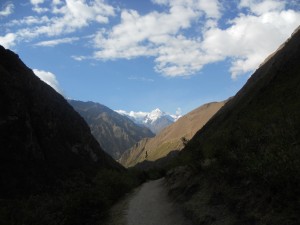
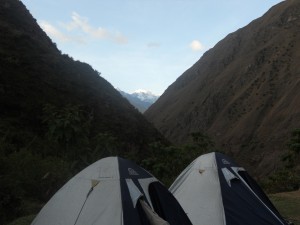
Our first-nights camp was in a village. A very small village on the side of the trail. The company had an agreement with locals to camp in what appeared to be their backyard. Chickens, big ones, ran around the tents, looking for handouts as we claimed our sleeping quarters for the night, and admired the view.
After another brief nap, and foray to the bathrooms (the bathrooms on the trip will require an entire and separate post), it was time to eat again. This time it was popcorn, potato soup, alpaca, eggs, and jungle potatoes – an extremely starchy potato that I was sure was filling us with energy for the morning.
Odon let us know that the Porters were monitoring how much we ate. Not only was it more weight off their backs, it was an indication of whether or not we’d be able to make it over the pass. We weren’t eating enough…so I reached for another potato or two.
Then he informed us that we could hire porters for the next day’s hike. The big one. Ten hours, summiting at 14,000 feet. If we wanted, he would arrange for porters to carry our bags. I’m not going to lie. I considered it. I asked him if I could make it and he said yes. He also said that there would be others coming back down the mountain tomorrow who wouldn’t. That he’d seen them and he knew who they were. When we asked how he knew, he said they had a different, “flavor†about them.
Then he told one of the guys in our group that he would have to hire a porter. And that it wouldn’t be a bad idea for one of the women, the one who was sick and coughing most of the time, to hire one as well. It was a blow. We could all feel it. Nobody wants to be told that they can’t make it on their own. But he was right.
By the end of the night, two porters had been hired. They’d be carrying two packs. They’d also be carrying the extra sleeping bag that I was carrying for LeAnna. We were traveling with one big bag and one smaller one, our gear consolidated. We’d planned to switch off, but I was holding up well, except for the blasted sleeping bag. It was rented from the trekking company and not designed to be light. I was glad to hand it over.
It was pitch black when we climbed into our tents. Each of us had our little headlamps lit for the brief time it took to crawl into the tents. And then it was black. Blissfully dark and quiet. The hard ground under us was lost as we drifted into sleep.

September 19, 2010 1 Comment
Making a splash at Restaurant Week
When I came to Las Vegas, it was with the full expectation that I’d be getting out into nature at every opportunity. I was one of those people that didn’t really think the strip was for me.
I was wrong.
Tonight I experienced something so spectacular, that I would come back to Vegas just to experience it again. “Wet Your Appetite,†the MGM Grand’s signature event for Restaurant Week was phenomenal. From the dozen or so restaurants that participated on-site, to the sneak-peaks at the MGM’s hottest shows, to dancers performing on a plexi-glass stage over the beautiful pool, it was amazing. Oh yeah, and there were mermaids.
That’s right, mermaids.
They were cruising around the enormous pool, flapping their fins. Chatting with anyone who would crouch down to talk with them. It’s safe to say that I did a fair amount of crouching tonight. The mermaids were really pretty.
Like the entire setting, the mermaids were something from a dream. The Wet Republic facility, where the event was held, provides over 4,000 square feet of outdoor event space. Chefs had food stations set with elaborate displays at every turn. The MGM has great fine dining, and Restaurant Week is a brilliant place to experience them . Plus, it does wonderful things.
Restaurant Week is a city-wide benefit for Three Square, a non-profit that works to end hunger in Southern Nevada. With special menus, and special events, over 90 restaurants in Las Vegas participate in Restaurant Week, making it one of the most anticipated food events in the city.
The highlight of my evening food-wise was a little “sweet burger slider†that contained no meat. It had a patty of nutella fudge, was topped with fresh strawberry slices, and had a – wait for it – Krispy Kreme bun. It was pretty much insane.
The highlight of my evening entertainment-wise was seeing a gorgeous performer from Crazy Horse Paris high-kicking on the plexi-stage over the water. And the guys from Recycled Percussion were pretty darn impressive, playing 10-foot step-ladders like drums, as they sailed through the air, sliding past the rungs and playing as they went.
The highlight of my evening overall, however, was feeding a mermaid chocolate mouse with gold shavings, poolside. Yes. I fed a mermaid tonight. I know you’re jealous. It’s okay.
If you find yourself in Las Vegas during Restaurant Week, make sure you get yourself to Wet Republic at the MGM Grand for Wet Your Appetite. I see no other solution. There are plenty of places you can swim with the dolphins, but I know of no other place on earth where you can feed the mermaids.
August 31, 2010 1 Comment
Archeology
I don’ t know what I expected to find in Peru, other than a long trail and a big-ass set of ruins at the end. I expected alpaca, llamas, guinea pig. I didn’t expect to find archeology everywhere. It reminded me of Athens, and Rome, the ancient mixed with the modern, built on top of, making itself seen in flashes of stone.
Our second day in Cuzco, Kelly suggested that we see some of the archeological sites in the surrounding valley.
“You can take a cab up to the highest of the four sites and then walk back. It’s like 7 miles. We can do that, right?â€Â We were pretty sure that we could. LeAnna and I were heading out the next day for the 4-day Inka Trail trek. And Kelly was recovering from an Achilles injury. The question was more whether we thought it was a good idea.
“I’ll go ask the front desk about it.â€Â Kelly headed downstairs while LeAnna and I took turns showering and getting ready for the day. When she returned, it was with a big smile on her face.
“It’s $5 for the taxi…and she said we can rent horses!â€Â We stopped pawing through our backpacks and looked up at her beaming face.
“Horses?â€
“Yes! You can ride horsed back down. Should I ask her to call a cab?â€
An hour later we were climbing into a hatchback, the three of us crammed in the back seat, grappling with the stubborn seatbelts.
The driver wound through the too-small streets, rattling along the stones, as people jumped out of the way onto sidewalks or up into doorways.
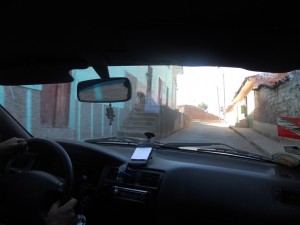
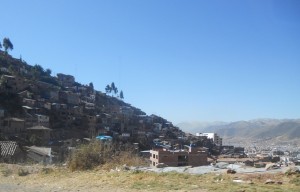
As we drove up and out, we were treated to a view of the city, nestled in the hills high above the distant sea.
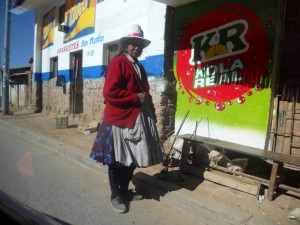
Here we found locals. Real ones. Dressed in the functional clothing that kept them both warm in the morning chill of 12,000 feet and safe form the uv rays of the sun, relatively unfiltered by the thin air.
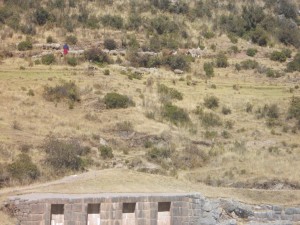
Our taxi driver dropped us at the topmost of the four sites we would see: Tambo Machay. We were greeted by dreadlocked donkeys and llamas rolling in the grasses.
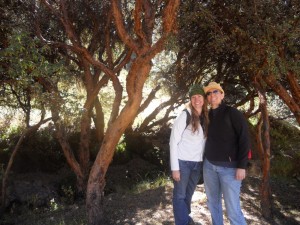
The focal point of this site was water. From the spring running along side the path leading to the ruins, to the incorporation of the water in the beautifully hewn stone, there was no question about its importance here. Beautiful trees grew on the banks of the little spring, shading the path, providing a rare bit of shade. Despite the biting chill in the air, we lingered out of reach of the sun’s searing rays.
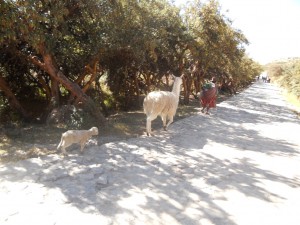
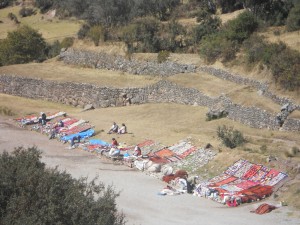
Merchants walked the path, back and forth from a make-shift marketplace at the foot of the ruins, carrying their wares and offering pictures with their livestock.
The archeological site was beautiful. The stones were smooth and impeccably placed. The thousand years or so of weather only a mild nuisance to its grand presence. The aqueducts were clearly deeper than they had been when they were originally cut into the rock; worn away by centuries of flowing water.
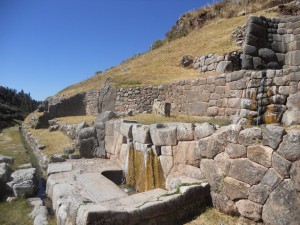
The niches, possibly used to display mummies – a connection with the afterlife – still retained their pink hue, and sharp angles.
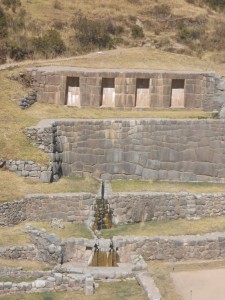
We climbed to a viewing area and surveyed the site. Locals gathered water from the spring, the market spread out in a colorful patchwork of textiles, and a shepherd brought his sheep along the ridge just above the site, the modern mixing seamlessly with the ancient.
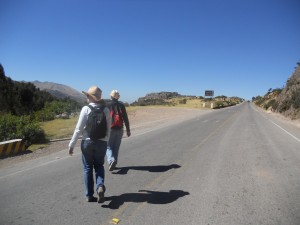
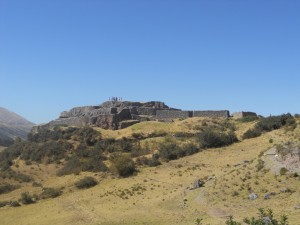
From Tambo Machay we walked down the winding road that had brought us from the city. Our next stop, Puca Pucara, was just across the way, a sentinel balanced over the valley.
If Tambo Machay was about water, Puca Pucara was about the earth and air. Wind whistled around the site, open on all sides to the elements.
When we walked up we found a young man and woman who wanted to show us the site. “Just for tips.â€Â We declined, but I was intrigued. “Without knowledge, this is just a pile of rocks,†he called after us. We had our guidebook, but his words stuck with me. How interesting that we had traveled all this way to see a pile of rocks. To walk on a pile of rocks that had been so carefully placed. How curious.
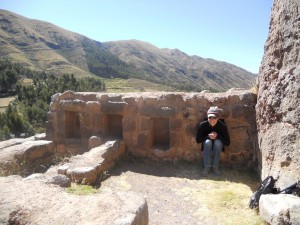
On the inside we found carefully constructed windows, small niches, walls built in harmony with the rocks upon which they stood.
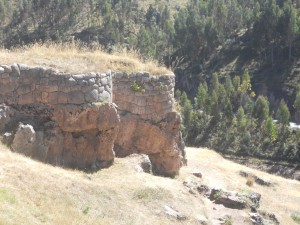
And a cave. LeAnna found the little opening, and we contemplated the intelligence behind entering. None of us had brought a head-lamp, which, in the end, probably saved us from making a foolish decision.
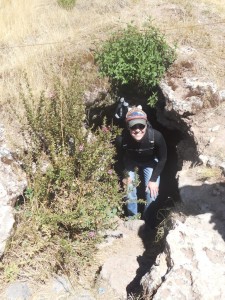
The thorn bush and stinging nettle pleaded with us to turn back. Which we did.
The site had a good number of rooms, layered on top of each other. We climbed stairs cut into the mountain, and spent time looking out at the valley. It was clear that this site was placed so as to offer a view, whether for aesthetic or military purposes. In fact, its purpose as either a hunting lodge or a fortress is still in question.
This was our first introduction to a couple of things. First, the small, uniform niches that decorated the inner walls of the sites. They were perfectly sized to house me.
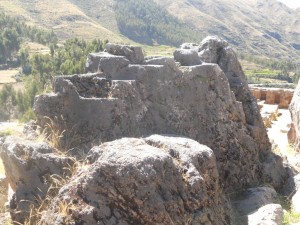
Second, we were introduced to the mountain-shaped rocks carved by the Inka, sacred objects that we would have walked by without knowing they were there. This stone at Puca Pucara was shaped like the entire site of Machu Picchu.
As we walked from the site, Kelly started to feel the uncomfortable crisp that was beginning from spending hours in the high-altitude sun. Even her stylish straw hat provided little protection.
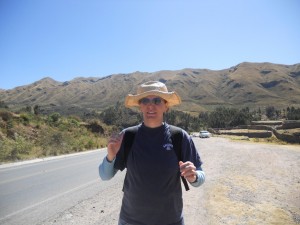
A quick reassignment of clothing resulted in a charming expedition-worthy outfit.
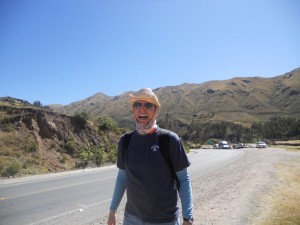
I think that one of the greatest parts of traveling with other people is that I don’t have to be the only one to look like a fool on a regular basis.
The walk between Puca Pucara and the next site of Qenko was the longest leg. We passed a wildlife refuge (about an acre of flooded grassland), fields of great clay bricks drying in the sun, and animals of all sorts.
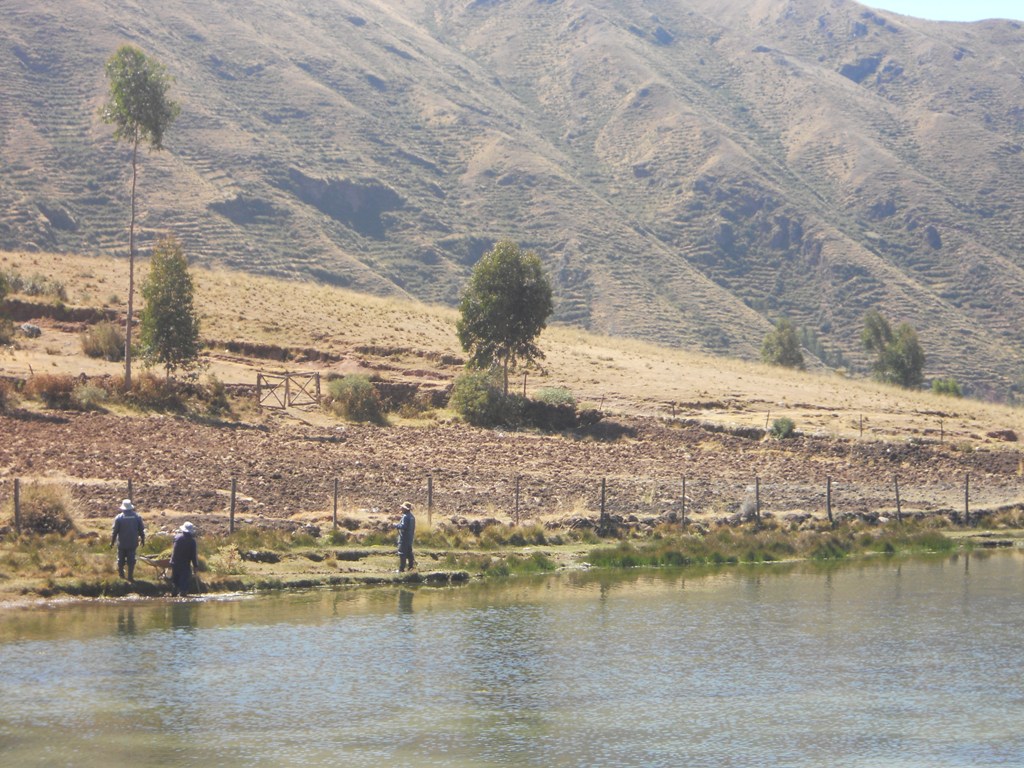
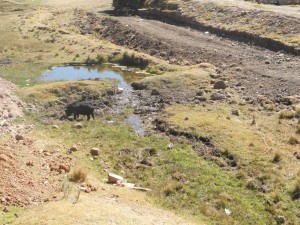
My favorite was a pig, ridiculously tethered to a clump of grass.
As we turned a corner, the road swinging wide out over the valley, we saw a pack of horses, and two men sitting in the grass. We all smiled and waved. We’d nearly forgotten about the horses! A quick negotiation, and we were on horseback, our guide walking beside us.
My horse was Palomo. A beautiful, dusty white guy who was assigned to me, after I volunteered that I’d ridden before.
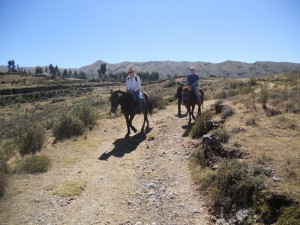
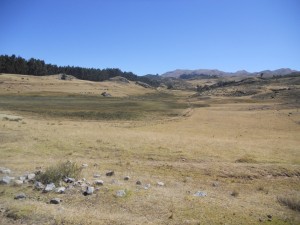
The ride was great. We meandered through the hills, cutting across the country-side, up and down rocky embankments, and splashing through wild springs.
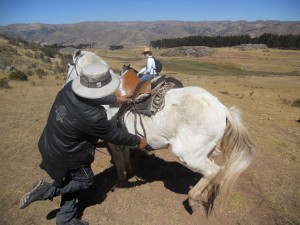
Kelly chatted in Spanish with our friendly guide, and I tried to slow Palomo who clearly preferred to run ahead of the pack. Only once did we stop, our guide ordering me off of the horse, and instructing Kelly and LeAnna to continue on. They looked at me and stayed put as our guide walked over to Palomo and adjusted the saddle, which had slipped back considerably.
With graceful movements, he adjusted the straps and moved with the horse when he sensed the argumentative kick coming.
As we neared Quenko, our guide gave us the go-ahead to let the horses run. That was what I’d been waiting for. All thoughts of a slipping saddle were thrust aside as I nudged Palomo on.  And we flew, through the hills of Peru, a huge smile on my face, and a chortling rumbling up from my soul. Up the hill and into a lane filled with other horses, and we landed, Palomo taking charge of where and when to stop.
We hopped down, said our goodbyes and headed up the lane in the direction our guide pointed. We were in a distinctly agricultural area now. Workers were bringing tubs of potatoes from the fields to dry in the sun.
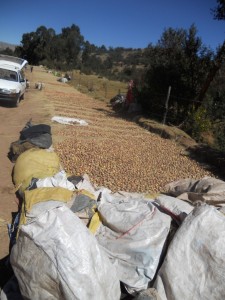
We spent the next while at Quenko. It was lunch time, and we made a familiar picnic of trail mix, dried peaches and cheese. The horses had been a delightful break in the day and we were all smiles as we hydrated and rested our thighs.
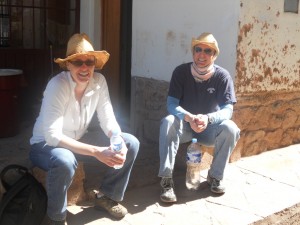
This site was different from the others. It was carved into the rock. Zig-zag channels and natural crags replaced the carefully-formed walls of the other sites. We walked along the path to the site, noting the differences.
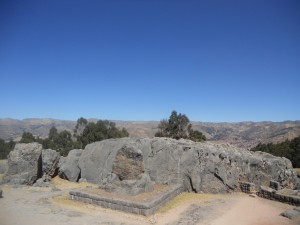
And then we were in the ruins. Literally, in them. Quenko was all about the earth. The great cave in its center was a clear focal point. The altar, carved from “living stone†is thought to have been used for embalming. Mummies were an important part of Inka culture, serving actively as a connection between this world and the next.
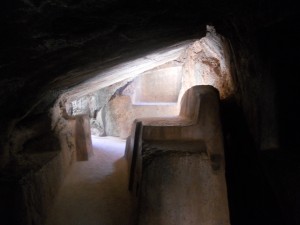
Between the altar and the niche at the far end of the chamber was a great crevasse. LeAnna and looked up at the piece of sky above, and the clear path to the surface. And then we jumped. She did a neat tuck and roll away from the edge, gently sloping down into the bottomless earth. I made a comment under my breath about not having health insurance. Halfway through the muttered doubt, I slammed the edge of my knee into the edge of the unforgiving stone. One day before the longest trek of my life.
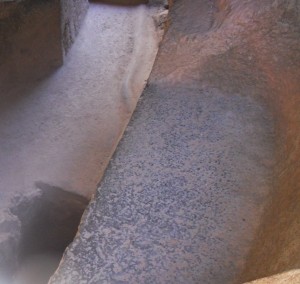
Even with the purple bruise already blooming, I was able to walk, so I shook it off and looked back, thankful that I was above, and not an offering to mother earth.
Up above, we met a young man anxious to talk with us about the site. Not for tips. He introduced himself and his culture and told us he was preparing to be a shaman.
“In two weeks.â€Â He had that long to prepare. He’d been coming to the site every three days for the last 6 months or so, and was ready to join his father, grandfather and great-grandfather as a shaman.
“That is a good sign for you,†he said pointing to two small butterflies that were fluttering together 5 feet from the ground.
He pointed out the phallus-shaped site visible from where we stood – the companion to the uteral cave we’d just escaped from – as well as the male and female mountains visible from where we stood.
We thanked him and walked back to the road. Without horses to guide us, we chose the road that seemed to be headed most directly down and began our journey to the final site. We walked past houses and fields, llamas and soccer goals.
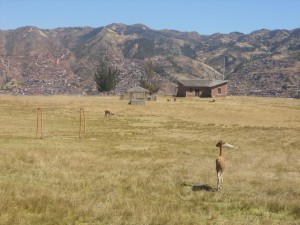
Sacsayhuaman (pronounced “sexy woman”) our final site for the day, was the largest, by far. The Cuzco region is said to be shaped like a puma. Sacsayhuaman is known as the puma’s head. The walls of the site form jagged, tooth shaped battlements – the puma’s mouth. Even from a great distance, it was easy to see why.
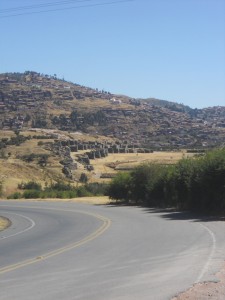
The road took us out of the way, through a small resort, and next to more llama pastures. As we walked past one, a herd of llama escaped, running through an unsecured gate. We considered whether we were morally obligated to attempt to wrangle the llamas.
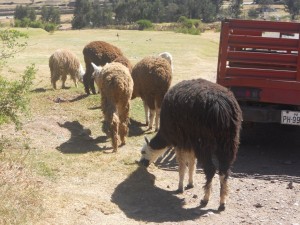
We decided, no. We were not.
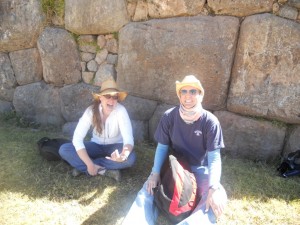
Once at the ruins, we found a spot in the shade to relax and hydrate.
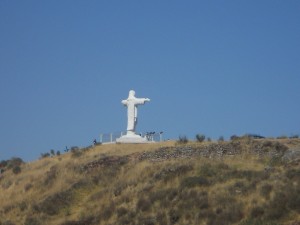
And to take in the enormous Cristo Blanco standing opposite the ancient Inka site.
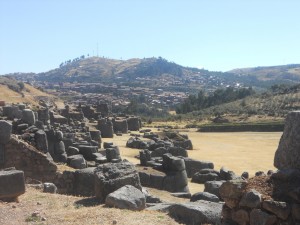
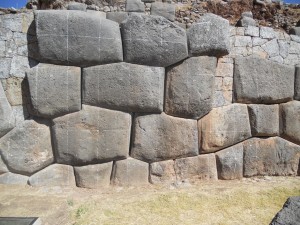
The site was gigantic. We spent at least an hour there and saw a small fraction of what there was to see. The stones that were used were incomprehensively large. One was something like 70 tons.
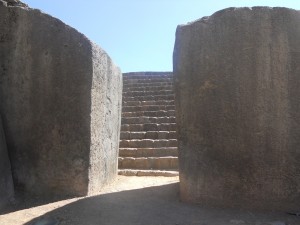
We wandered through the doorways, up the steep stairs, along terraces.
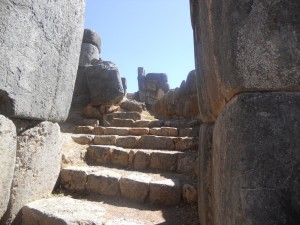
We contemplated the strange, chalk grids marked on the walls, designed to help reconstruct the site in the case of an earthquake.
I also perfected my Peru look.
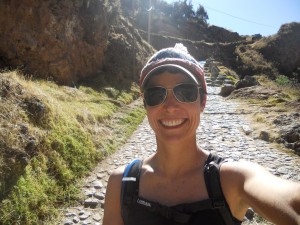
The hat kept me warm, the camelback kept me hydrated, and the tank let me get some sunscreened rays.
And then we went in search of the old Inka trail that our guidebook said we could take form the site down into the city itself. But there were a lot of stone trails. Eventually, we chose one that we thought looked promising, and headed down hill on the worn stones.
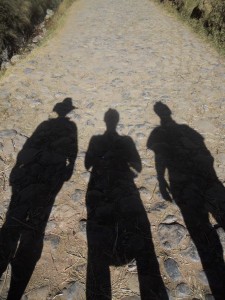
We made our way back into Cuzco, alongside the stray dogs that inhabit the streets. Along side the tiny, old women walking the sidewalks, and the insane motorcycles carrying propane tanks strapped to their metal frames. We walked back into the city with a boy and his grandfather carrying loads of rubbish on their backs.
We walked back into the city and directly into a pizza place.
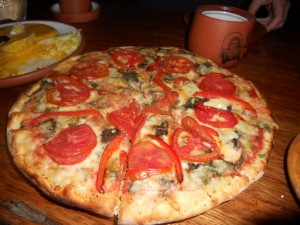
Along with the excellent pizza we had what became our favorite meal, avocado relleno.
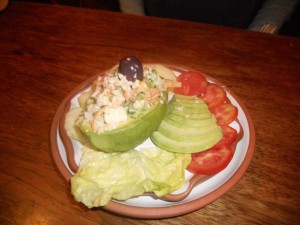
One of the vegetable dishes that we could eat, the avocado relleno was stuffed with boiled vegetables and cheese. It was delicious.
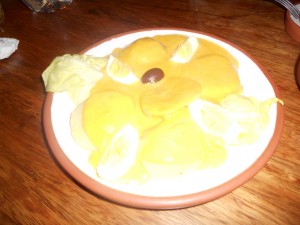
We also sampled a local potato and egg-sauce dish that wasn’t shabby, even if we weren’t exactly sure what we were eating.
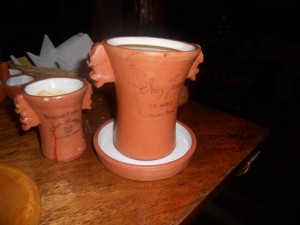
And we each had a local beverage. LeAnna opted for some kind of juice, Kelly for hot chocolate, and I won out with a huge mug of coffee, served concentrated with a beaker of hot water.
While we ate, the World Cup played in the background. Locals leapt up periodically to cheer on a particularly good play. We spent the rest of the evening doing laundry, walking the Plaza Armas, and in a briefing for the next day’s Inka Trail trek. But generally we were waiting until it was dark enough for us to return to the cake shop for dessert.
Which we did. It was good. I even ate a cheese sandwich. And I think we shared four desserts. But we’d been walking and riding and learning all day, so we were hungry.
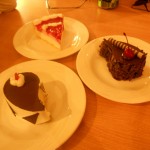
With full stomachs, we went to bed early, ready to wake up at 4AM and catch our shuttle to the Inka Trail, and our next adventure.
August 24, 2010 1 Comment
Group therapy
A friend of mine invited me to attend a Write Around Portland writing work shop this morning. It was in response to a comment I’d made about how much I love writing. So I felt like maybe I should try the exercise in group writing, and not run away and cry in the corner, remembering the decades of rejection that I have stored in the back of my consciousness from other group writing experiences.
Seventh grade English, for example. Or college.
I chose Business as a major, yes because it was a “marketable degree†but also because it was one of two majors that didn’t require the writing of a thesis.
Law School was fine when I was able to write by formula, but the heartbreak that came from undeveloped ideas and half-formed theories tossed onto a page and desperately rearranged in an attempt to make something, anything coherent still makes me cringe when I think about group writing and the feedback process.
But I’m not one to run from discomfort.  Oh no.  So I put my little laptop in my bike bag, knowing that I’d probably have to write by hand, but wanting a reminder of my new, comfortable writing near me.
I walked into the back room of the restaurant where the group was meeting a couple of minutes late. I smiled at my friend, and grabbed a cup of coffee, pastry and a journal.
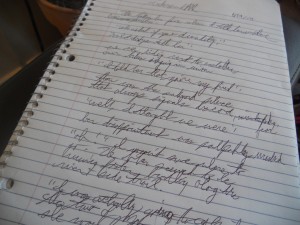
The little spiral notebook made me laugh. The other writers had fancy journals and favorite pens. I had the ballpoint I’d stolen from the US passport office a year ago.
Over the next two hours, the 14 of us wrote three, timed, freewrite pieces. The kind of thing that is supposed to flow freely from your deepest, darkest inside. The kind of thing where you don’t take your pen off of the paper. The kind of thing where you write the entire time, no matter what.
The only thing is that I don’t write like that. I type. Partially because I can’t read my own handwriting. It’s the only thing I ever got below an “A†in while I was in elementary school. Handwriting, no matter how hard I tried, no matter how much I practiced in the books with the guidelines like miniature roadways, the dotted lines marking the approved mid-way of the letters, no matter, all I ever got was a “Câ€.
The other thing is the fluidity with which I type. I’ve had more than one person note the flourish I put on the end of a well crafted sentence. The upstroke of my right hand as I type a period with my ring finger, and a return with my pinky. It’s musical. Evocative of a certain fabulous pianist. I love to write, and I love to type. In fact, typing games have long been my favorites on computers, from the Texas Instruments keyboard through Facebook.
So I found myself this morning, without keyboard, in a group writing workshop. It was my love of workshops, and my love of writing that kept me seated, even as my hands and voice shook while I read through the bits of dialogue that I was able to scrape together during the 5 minute writing sprints.
“We believe in positive feedback.â€Â That was one of the guidelines we were given. And there was much of that. We were gentle with each other, and with ourselves. The self-imposed vulnerability of the exercise was remarkable. The group of 13 women was joined by one lone man halfway through. Someone who chose the “other†prompt when we were given two at the beginning of each write. The absence of men was noticeable. Something I’d planned to write about before he appeared.
Instead, I sat tight and wrote using the prompts – simple phrases designed to open us up and get us writing. From the time our facilitator said, “go†until she said, “finish up the thought you’re working on,†I wrote. In my barely intelligible scrawl, I wrote. It was like seeing myself in an old photo. The lines were familiar, friendly. I had forgotten how much I enjoy the freewrite. Although my typing is similar. I rarely edit, more than moving paragraphs around. Maybe that’s a mistake, but I enjoy sharing what comes to the surface without the polish that fear of exposure can bring. It’s a kind of therapy for me to allow myself that level of authenticity. And in that spirit I’m sharing the three pieces from today’s workshop. The first two were 5-minute writes. The last one-minute.
Today’s writings were unpolished. And familiar. I hope they are as enjoyable for you as they are for me.
Prompt: The look on her face…
The look on her face when I told her must have been priceless.
“She asked if you and I were dating.â€
“What did you tell her?â€
We were riding next to each other, our bikes singing in unison.
“I told her that you’re my friend.â€
There was the awkward silence that always signals discord, misunderstanding, fear.
“Well, I thought we were.â€Â Her disappointment was palpably masked.
“Oh!â€Â I wasn’t sure where to go. The bikes seemed to be running faster, hurtling along the river-side trail.
“I was actually going to ask if the two of you were dating,†she was laughing a little.
“Not sure,†was about all I could come up with. Truthfully, I didn’t know. I didn’t know what it meant, what the rules were, when it moved from biking buddies to more.
I turned to her for a moment. “Funny. I was going to ask you the same thing.â€
Prompt:Â Once the fire was out
“Where were you? We’ve been trying to reach you?â€
My mother’s voice was the kind of panicky usually reserved for the middle-of-the-night phone calls.
“I was in nature. I’m sorry.â€
The voicemails were stacked thick when I reached the parking-lot after the weekend gathering mushrooms on forest service land.
“Kristin, please call us.â€
“Kristin, where are you? Mom’s trying to reach you.â€
“Kristin, there’s been a fire.â€
My entire family was calling, thinking that I was simply on a binge of self-absorption, ignoring the pestering buzzing of my phone.
“I was gone for one day, Mom.â€
“But we didn’t know where you were, and the fire almost took the cabin. We had one hour to clear out.â€
Thoughts raged as I shoved aside my defensiveness and tried to comfort my mother through the phone.
“How can I help, Mom? Should I drive over? I’ll leave now.â€
“No.â€Â She was breathing again, her words heavy. “No, it’ll be fine once the fire is out. I just wanted to hear your voice.â€
Prompt: Summer didn’t…
Summer didn’t know if she was dating either of the women.
August 19, 2010 3 Comments
Cuzco is for addicts
We got into Cuzco early. It was about 8AM when our driver dropped us at our hostel. I’d never stayed in a hostel, and images of bunk beds and shared showers had me a little worried. But when we walked through the blue doors on the steep street, into a beautiful courtyard, I stopped worrying.
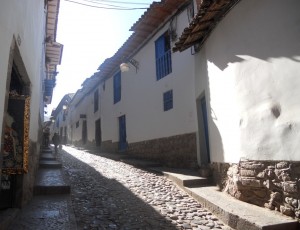
The woman at the front desk took our passports and spoke with Kelly in Spanish. We designated Kelly our primary Spanish speaker, because she’d been studying the most. She was so eager to speak, that even when the other woman told her she could easily speak English, Kelly refused. So LeAnna and I listened and nodded along as Kelly confirmed our reservation and bought 3 huge bottles of drinking water.
Because we were there so early, the room wasn’t quite ready, so we tossed our bags in a corner and struck out to see the city.
Cuzco is high. It sits at 12,000 feet above sea level. I grew up at 7,000, with regular trips to 9,000, but the only time I spent above 12,000 was on Hawaii’s Mauna Loa for my 30th birthday – where we all became giddy from altitude sickness. As we toddled out into the streets, it was with awareness of the distinct shortness of breath that accompanied the clear, blue sky.
We made a circuit around our part of town, stopping at the train station and airline office to confirm parts of the next leg of the trip. Kelly and LeAnna would be continuing on to Lake Titicaca and the Amazon. While they talked timetables and layovers, I consulted Kelly’s guidebook, and dozed lazily in the plastic chairs of the waiting areas. I located the Plaza Armas on the map (the main historic square) and read about its history. Then I turned to the really important thing: food. I had no interest in eating llama, or the local staple, cuy – guinea pig.
There were pizza places everywhere (I’m guessing because the wood-fired ovens used for cooking the cuy are a natural fit for pizzas). The guide book suggested an interesting place off of the plaza, and I filed it away for later.
We tramped through the streets in a jet-lagged haze, making our way to the plaza.
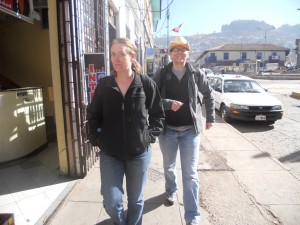
The light seemed strange. Filtered, somehow. It was bright and made the morning feel much later than it was. The streets of Cuzco were coming alive, its cobblestones reminiscent of, but more raw than those of Italy.
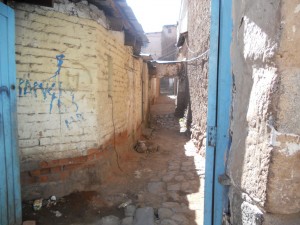
The lanes offered beautiful scenes of daily life mixed with simulated authenticity.
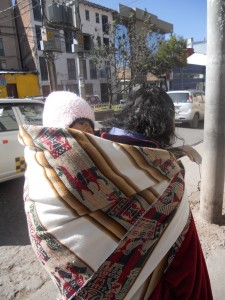
Mothers carried children of varying size and age under blankets wrapped tightly around their backs, little hats poking out from the bundles. I covertly snapped a shot of what was remarkable to me, and completely commonplace to the locals.
Then, just off of the plaza, I saw something colorful and furry.
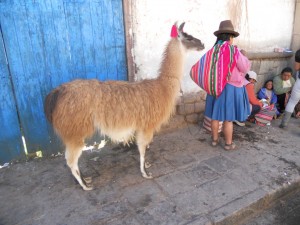
When I ran over to take a picture of an “authentic†Peruvian with a llama, I didn’t know that I was supposed to pay for it. These women make their livings selling snapshots of their clothing, animals and weaving.
The plaza offered great views, bounded on two sides by enormous churches that had competed for the Vatican’s attention and the Pope’s declaration of “most beautiful.â€Â The cathedral (the Pope’s choice) was built on the base of an Inkan temple. The other was a Jesuit church.
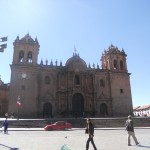
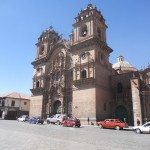
We had a look around at the brown, brushy mountains and the images of pumas everywhere, scoping out a good place to sit.
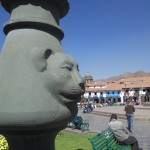
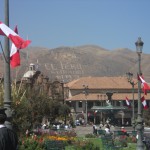
The guidebook said that the plaza still served as a marketplace. By sitting in a park bench, you could avail yourself of vendors. Paintings, jewelry, knick-knacks, tours, paintings, massages and all other manner of items were pedaled to us, as we claimed our view on the plaza.
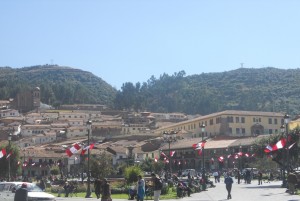
We became more comfortable talking with the vendors. Unlike the vendors on Italian beaches, these vendors would take the time to let us look at their wares, and then move along when we declined, with a polite, “maybe later.â€
The maybe later made us laugh a bit. The third time we heard it we realized that it was ubiquitous.  We decided it must be a way to keep the conversation open for the next time we entered the plaza. Because the vendors remembered us every time we entered the plaza.  “You remember me? I showed you paintings yesterday. I am Pablo Picasso!â€Â The young men sold mostly paintings. The women crafts. Silver jewelry and carved gourds. Textiles and postcards, and everything under the sun, pulled from bags and displayed one after another with immense patience.
With one woman, the most assertive vendor we met by far, I tried out my theory. After looking at her carvings, I smiled and said, “maybe later,†thinking I was politely ending the conversation.
“Maybe later is no good for me, lady,†was her response.  I think I burst out laughing as my self-designated cultural awareness was flung out the window.
The morning nearly over, we headed back to our hostel, stomachs grumbling.
Our front desk friend greeted us with a big smile and a grinned, “como estan?â€Â Our bags were already in our room, and all we needed was our key, which was turned-over heavily to Kelly.
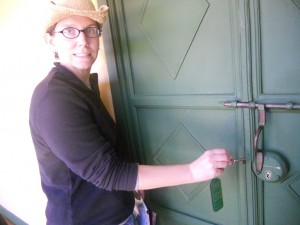
She took command of the huge skeleton key and we made our way up to our second floor room overlooking one of the property’s courtyards.
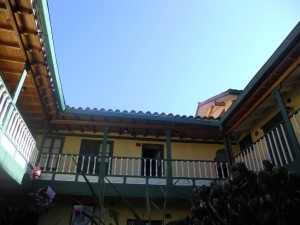
Then we spent some time figuring out the surprisingly complex locking mechanism
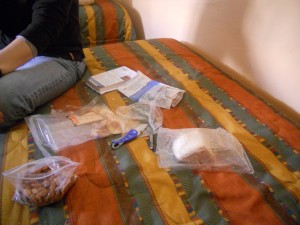
By the time we got in the room and threw down our gear we were appropriately hungry. Working together we came up with a fantastic meal of almonds, dried peaches and an Italian pecorino cheese that I’d smuggled out of Italy and into Peru.
Other places have things that the US doesn’t have. Rooms for more than 2 single travelers, for instance. Our room had four single beds. We each claimed our own and designated the fourth as the gear bed. Then we marveled at our accommodations. Along with the four beds, we had our own, private bath, internet access, breakfast, and all the coca tea we could drink. All for $55 a night. Total.
But back to the coca…
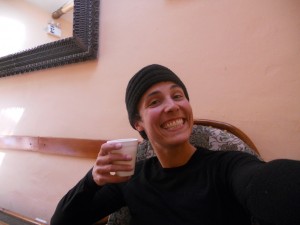
When I told people I was going to Cuzco, they all said the same thing, “drink the coca tea.â€Â I like tea, but I don’t like introducing my body to new addictive substances. Just doesn’t seem like a good idea. So I’d planned to tough it out without the benefit of the coca. But the shortness of breath, sleepiness and vague head pain I was experiencing, along with the pots and pots of coca tea provided by the hostel convinced me that I might be better off joining the locals.
And I was.
LeAnna and I sipped the tea, while Kelly, who would not be spending the next week hiking, looked on. We had no interest in finding ourselves with altitude sickness two days before the four-day trek that was ahead of us.
The tea is made from coca leaves – that’s coca, not cacao – the leaf from which cocaine is extracted. It lowers the blood pressure, and allows your body to absorb oxygen differently. So, in effect, we were doping up for our trek. It did the trick with our headaches. Tea in hand, we all moved into the second, terraced courtyard where scores of traveling students were clutching their own styrofoam lifelines and taking in the mountain air. After a couple of cups, LeAnna and I found ourselves lounging in the sun, our hearts beating insistently in our chests.
Beating aside, we were sleepy. The 20 hours of travel finally caught up to us, so we soon headed to our bunks for a high-altitude nap. In our little beds, we crashed. My last thoughts were of the blood rushing through my heart. LeAnna, on the other hand, was graced with dreams of falling off of cliffs. The coca tea was potent. Kelly slept like a baby.
When we awoke, the day was moving into evening, which meant we could head to dinner. Yay. We pulled out the guidebook once again and I found the restaurant I’d identified earlier. The addicts in us were most excited about a good cup of coffee (because we needed more stimulation), and the “cultural center†atmosphere promised in the book sounded interesting as well.
Books lie. Or they become outdated at an alarmingly fast rate. We found the restaurant, and climbed the spiral staircase to the second floor. We were the only ones there.
We looked out the top floor window onto the streets, and then looked at each other.
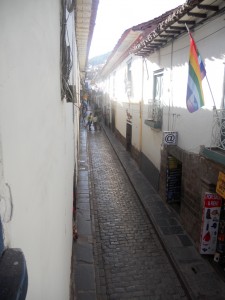
Maybe we were just early for dinner. Maybe there were new owners. Maybe it would pick up.
We were game for staying, but only because we were hungry and had no other lead on food. And we wanted Peruvian coffee. “So, do we drink the coffee?â€Â LeAnna asked the strange question and we looked at her quizzically. “Well, it’s made with water, and I’m pretty sure they haven’t boiled the water for 10 minutes.â€
Damn. None of us had considered this. Parasites weren’t on the list of things we wanted to take home from Peru, and the drinking water wasn’t safe.
A quick debate ensued regarding the drinking of coffee. LeAnna and I came down on the side of “screw it, we’re in Peru, we’re drinking the damn coffee.â€Â Kelly came down on the , “can I have a sip†side.
While we waited for our coffee, we checked out the menu. Along with cuy and other, unidentifiable items, there was a pizza list. Which sounded delightfully comforting. We were adventurous, but hungry. After discounting local fare, we ordered my personal favorite: pizza with olive and pineapple. Delicious. The olives turned out to be Kalamata, a change from the usual, but tasty.
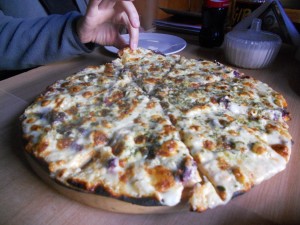
And the pizza was good. Surprisingly so. We gobbled the pizza and slurped tentatively at the coffee. Which was divine. All thoughts of what could be lurking in the water was tossed aside as we tossed back the beautiful-smelling elixir.
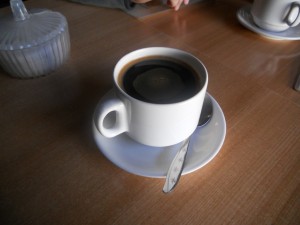
And as we tossed back, we looked up to find the strangest part of the place.
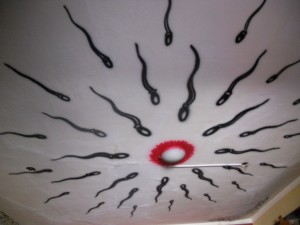
Sperm. Fertilizing a ceiling lamp. Yes, that’s what I said. I don’t know. I didn’t ask. We’re assuming this is the “cultural center” to which the booking was referring. Who knows?
Our stomachs happy, we sat and considered the rest of our time in Cuzco. We’d need another place to eat.  And we might need dessert. While we were a little hesitant to consult the guidebook again, we weren’t ready to accept the recommendations of the hoards of barkers trying to bring in business from the streets.
The guidebook listed a European bakery. A place where we could get more coffee and a piece of cake. Potentially perfect.
Kelly needed an internet café, so we worked our way down the main street, searching for a shop that looked both legit and safe. At every corner was clogged and we were barraged by women with handbills asking if we wanted massages. “Maybe later,†we answered, and they agreed.
When Kelly entered the back of a shop, LeAnna and I sat waiting, catching up on each other’s lives, and musing about the days ahead.   Sitting there talking about the emotional and the mundane, we were treated to a preview of the camaraderie that would thrust itself upon us as we made our way through the truly foreign experience lying in wait.
And then we were walking again, through the streets of Cuzco at dusk, past murals of a maturing justice, and fountains and tourists and locals. Toward pastry.
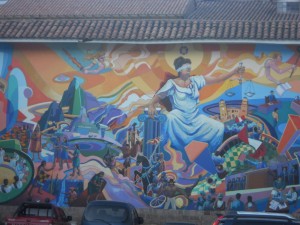
We would visit the pastry shop every night that we spent on Cuzco. We would order a total of 10 desserts in the three visits. Nine of them would be delicious.
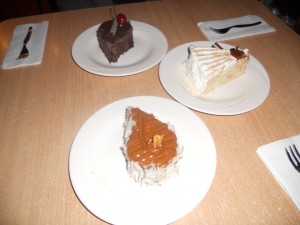
The shop was lovely. White-shirted, black-aproned Peruvian boys waited by the door, hands clasped behind their backs, their dark hair and eyes sparkling at the mix of locals and tourists streaming in and out.
Our three desserts and coffees were consumed, and we laughed lightly, comforted by the familiar look and feel of the place. Caffeinated and sugared, we stepped out into the dark plaza in front of yet another ornate church, where we found a backlit Mary standing watch.
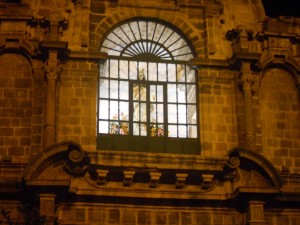
Odd churches were nothing new to me, and I was interested to see the Peruvian flair overlaying the Catholic basics. Kelly and I stepped inside to find one of the strangest church interiors I’ve ever seen. A couple dozen life-sized saints stared down at us from high niches. Wooden or ceramic, each of them was dressed in real clothing. Satin, lace, wool. They all had complete textile clothes. Some had jewels. I wouldn’t have expected this to be so strange, but it really was. Instead of the feeling of benevolence I have felt from the carved statues of saints, this felt like life-sized dolls staring at us as we made a circuit of the large church.
LeAnna, who had wanted to be culturally sensitive, came in to see what was taking us so long. I’m sure we had wide eyes, due to caffeine overload, and the strangeness of the scene.
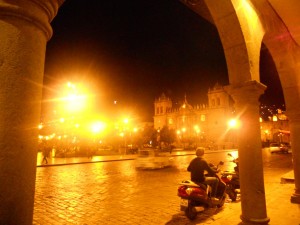
We weren’t far from our hostel, just on the other side of the Plaza Armas. Despite our sugar highs, we were starting to fade. As we walked back, the night took on a fuzzy, sparkly feeling, the scooters rattling past us along the ancient stones.
August 16, 2010 2 Comments